
Home › All pioneers › Galen
Physical Culture & Training Science · Populariser
Galen
Galen had been a physician to gladiators. He also wrote in praise of a game played with a small ball, and part of his case was who could afford to play.
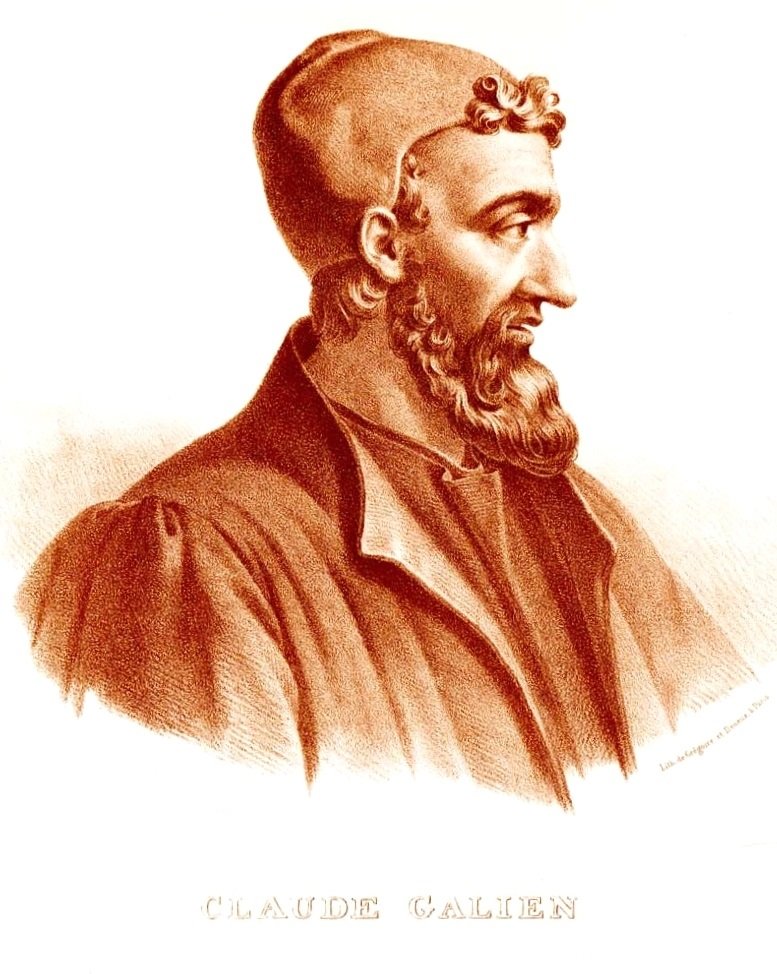
Image credit
Pierre-Roch Vigneron, lithograph, before 1872. Public domain, via Wikimedia Commons.
In one breath · Why would a physician write about a ball game?
Galen wrote a short work arguing for exercise with a small ball. Part of his case was about access. An elaborate hunt calls for time, animals and equipment, while a person with a trade or public duties can find the time and means for a ball. It is a medical author’s reasoning about exercise, never a study of results.
At a glance
- Known for
- On Exercise with the Small Ball, a surviving Greek work that argues for a ball game as exercise.
- Role
- Physician. He cared for gladiators at Pergamum, then practised and wrote in Rome.
- Dates
- Born 129 CE in Pergamum, a Greek-speaking city in Roman Asia. He lived into the early third century.
- Addressed to
- Epigenes, whom Galen asks to judge the argument.
- Read it in
- Kühn, Opera Omnia, volume V (1823), pp. 899–910. English rendering in F. A. Wright, Greek Athletics, pp. 112–115.
- Kind of evidence
- An author’s argument. There is no player’s testimony and no record of how many people followed the advice.
Why Galen asked an expert to consider an ordinary ball
Galen was born in 129 CE in Pergamum, a Greek-speaking city in Roman Asia, and lived into the early third century. His architect father encouraged wide study. Medical training took him to several centres, including Alexandria. Back in Pergamum he cared for gladiators, and later practised and wrote in Rome in the world of the imperial court. The early experience offered prolonged contact with professional athletes. It cannot establish the occasion of every remark he made about exercise. [1] [2]
In On Exercise with the Small Ball, Galen asks Epigenes to judge his argument, praising his skill without identifying his profession. He chooses an unassuming object and asks who can afford to use it. An elaborate hunt calls for time, animals and equipment. A person pursuing a trade or public duties, he contends, can find time and resources for a ball. The statement is an argument about access in the physician’s social world. It is unusually concrete evidence of the considerations he wanted his reader to weigh. [3] [4] [5]
Galen’s argument in one view
An elaborate hunt asks for
- Time
- Animals
- Equipment
The small ball asks for
- A ball
- Time and means that a trade or public duties still leave
What he says the game brings
- Enjoyment
- Competition
- Concentration
In section 3 he describes a player anticipating where a moving ball will go, and catching it in different positions.
Galen gives enjoyment, competition and concentration a place in this argument. A player has to attend to what happens to the ball, and the pleasure of succeeding matters in his account of the experience. Elsewhere he caricatures professional athletes as so absorbed in their bodies that they neglect their minds. Read together, the passages disclose a writer defending one kind of play and attacking another way of life. The second is a polemic about the values of his day, and the first is a medical author’s reasoning, never an outcome study. [3] [4] [6]
Modern scholarship situates the small-ball work alongside games associated with Roman public baths. That social reading helps explain the potential audience. It does not locate Epigenes inside a specific bath, supply a player’s testimony or show what proportion of people followed Galen’s advice. The gap between an elite Greek medical writer and the people he imagined playing is part of the history of the work. [1] [2]
What the record doesn’t show
- That gladiators trained with the ball exercise.
- What Galen’s own exercise looked like.
- How many people followed his advice.
Related pioneers
These are comparisons of texts, audiences and forms of authority. No exchange between these individuals has been demonstrated.
Sources
- Stanford Encyclopedia of Philosophy, Galen, Life and Work
- Galen on Roman Amateur Athletics, Arete II:2 (1985), pp. 171–172
- Galen, De parvae pilae exercitio, Greek text
- F. A. Wright, Greek Athletics, chapter on Galen, pp. 112–115
- Galen, On Exercise with the Small Ball, §3, Marquardt’s 1879 Greek edition, digital Graeco-Arabic Studies transcription
- Galen exhibition catalogue, Movement, pp. 82–83