
Strength & Physique · Populariser
Abbye “Pudgy” Stockton
The Santa Monica beach athlete who wrote the Barbelles column in Strength & Health from 1944 to 1954 and opened a women’s gym in Los Angeles in 1948.
From the Santa Monica beach to a women’s lifting meet
Abbye Eville, later Stockton (1917–2006), was working as a telephone operator when she and Les Stockton began going to the exercise area south of Santa Monica Pier in the late 1930s. The beach offered room for weightlifting, hand balancing, human pyramids and gymnastics. The two married in 1941. Stockton later recalled learning calisthenics at home from health magazines and library books before Les brought her dumbbells. Todd reports wartime backyard training in Oro Grande, California, and Stockton’s demonstration of the three Olympic lifts at the Los Angeles YMCA. Their partner balances made her strength visible to spectators without requiring them to understand competition lifts. Photos of those performances then took Muscle Beach to magazine readers elsewhere. [1] [2] [3]
Between 1944 and 1954 she wrote Barbelles in Strength & Health. The column gave women a place to appear as participants rather than solely as spectators at men’s competitions. Historian Jan Todd identifies an August 1944 column (p. 11) discussing organised competition and an April 1947 report on a meet. Stockton used the column both to argue for women’s competitions and to report what happened when women competed. Readers’ advice and the author’s private practice remain distinct. [2] [4]
On 28 February 1947 the Pacific Coast Weightlifting Championships at the Southwest Arena in Los Angeles brought nine women together in three bodyweight divisions. Todd reports that Stockton helped organise the meet, the earliest US women’s contest with AAU sanction that Todd could trace. At a recorded 118 lb Stockton lifted 100 lb in the press, 105 lb in the snatch and 135 lb in the clean and jerk. A competition total derived from those three lifts would be 340 lb. It describes her result under those rules. It should never be confused with a bar held during a partner balance. [2]
In 1948 Abbye and Les opened the Salon of Figure Development, a women’s gym on Sunset Boulevard in Los Angeles at or alongside the Marcy House of Health. In 1950 they opened adjacent studios on Pico Boulevard in the Beverly Hills area. Todd and the Stockton papers’ finding aid record a further Pasadena gym in 1952 in partnership with John Farbotnik; a later Los Angeles Times feature describes it as a move. The people who had performed in public could now offer women a regular place to train. Pictures of Stockton could widen the range of bodies women saw in public while editors still framed her through domestic expectations. The Los Angeles Times identified a magazine feature that paired images of her lifting with photographs of her sewing and washing dishes. A 2006 Los Angeles Times obituary reports that Stockton recalled in a 2002 interview that she and her friends laughed at warnings about what lifting would do to women. That is her later report of how they responded. [1] [2] [4] [3] [5]
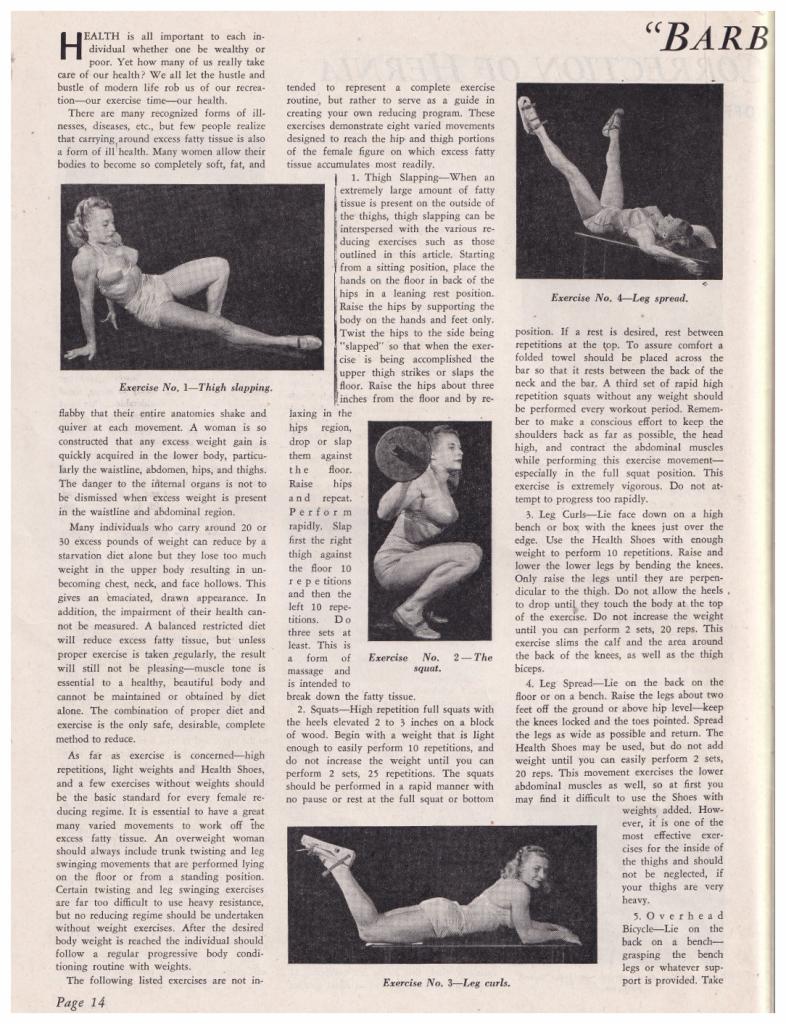
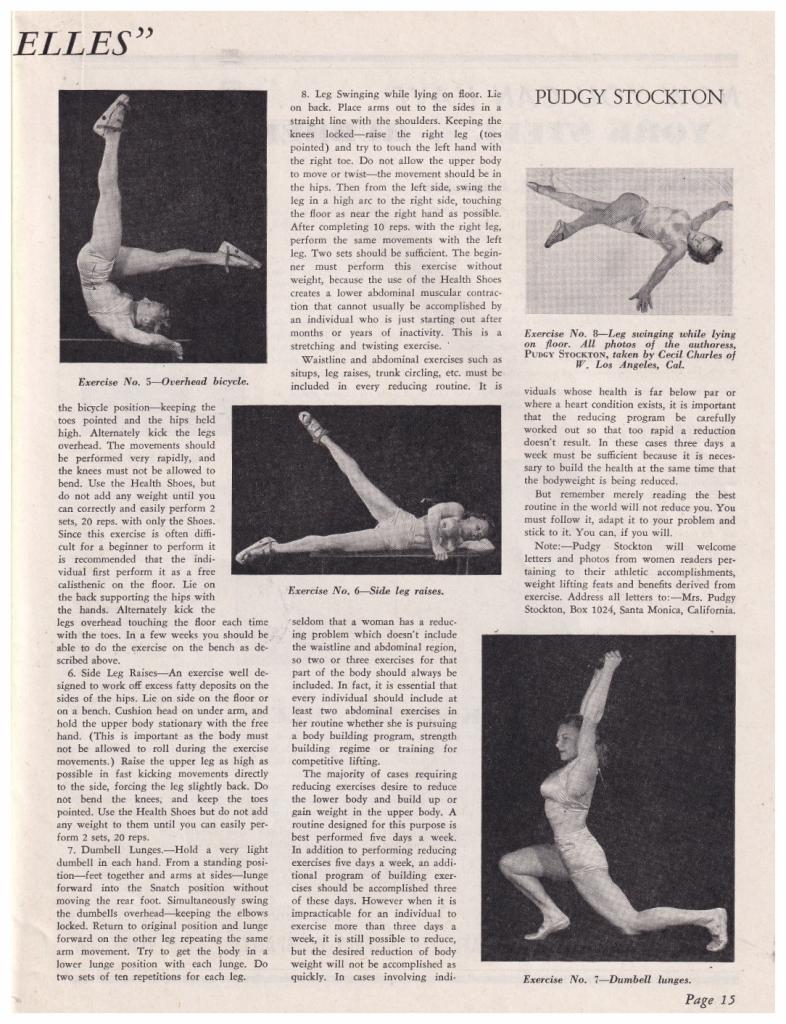
In March 1947 Stockton used two pages of Barbelles to present eight illustrated movements for the hips and thighs, including squats and dumbbell lunges. The photographs show Stockton demonstrating the movements; the text presents them as a guide, not as a complete routine. In a closing note she invited women readers to send letters and photographs about their lifting and other athletic accomplishments. This documents what Stockton taught and asked for in print, not how she trained privately or whether the column’s claims about fat loss were correct. [6] [7]
Related pioneers
Sources
- Los Angeles Times, Abbye Stockton, 88, 30 June 2006
- Jan Todd, The Legacy of Pudgy Stockton
- Marla Matzer, The Venus of Muscle Beach
- Stark Center, Barbells & Bios: The Stockton Papers
- Stark Center, Stockton papers finding aid
- Pudgy Stockton, “Barbelles”, Strength & Health, March 1947, p. 14
- Pudgy Stockton, “Barbelles”, Strength & Health, March 1947, p. 15